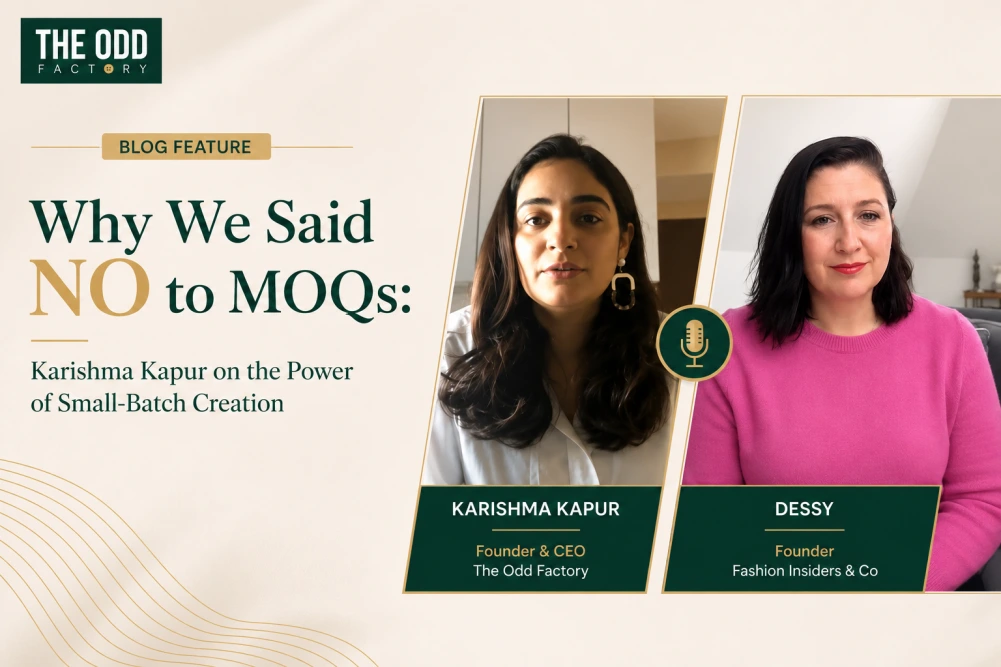
More than six years ago, Karishma Kapur, Co-Founder & Proprietor of The ODD Factory, joined Dessy, Founder of Fashion Insiders & Co., for an insightful discussion on fashion manufacturing in India. Although the interview was recorded years ago, the topics they explored ethical manufacturing, low minimum order quantities (MOQs), transparent communication, and people-first production are even more relevant in today’s fashion industry.
As fashion brands increasingly embrace sustainability, limited-edition collections, and demand-driven production, the philosophy discussed in that conversation continues to shape how The ODD Factory works with designers and entrepreneurs across the world.
Building a Fashion Brand Shouldn’t Start with Massive Order Quantities
For independent fashion designers and startup clothing brands, one of the biggest obstacles isn’t creativity, it’s manufacturing.
Many traditional garment manufacturers still require high Minimum Order Quantities (MOQs) before accepting production. While this model supports mass manufacturing, it often forces emerging brands to invest heavily in inventory before validating their products.
High MOQs can lead to:
- Large upfront investments
- Excess inventory
- Increased financial risk
- Textile waste
- Slower business growth
More than six years ago, Karishma Kapur discussed this very challenge during her interview with Fashion Insiders & Co. Today, as fashion moves towards small collections, capsule drops, and sustainable production, those insights feel more relevant than ever.
Watch the Original Interview
The interview below was recorded over six years ago, but many of the ideas shared continue to reflect the realities of modern fashion manufacturing.
Whether you’re launching your first fashion brand or scaling an established label, you’ll find timeless insights on ethical manufacturing, small-batch production, transparency, and building long-term manufacturing partnerships.
Why The ODD Factory Choose a Different Manufacturing Model?
Karishma’s journey into fashion manufacturing wasn’t traditional.
With a Master’s degree in Economics, she began her professional career in banking. Although the role offered stability, she realised her passion lay in creativity, product development, and entrepreneurship.
She started by creating customised garments and working with factory surplus fabrics for local designers. Soon after, an opportunity to manufacture garments for an international client encouraged her to establish a small manufacturing unit with just four sewing machines in her Mumbai garage.
That small beginning eventually grew into The ODD Factory.
The name itself reflects the company’s philosophy.
Operationally, ODD stands for Order • Design • Dispatch the three essential stages of garment production.
Philosophically, however, it represents doing things differently. Instead of chasing production volumes, The ODD Factory focuses on creativity, craftsmanship, flexibility, and collaboration.
Why Low MOQs Matter More Than Ever?
When the interview was recorded, Karishma explained why The ODD Factory deliberately chose not to operate like traditional high-volume factories.
Six years later, that philosophy has become even more relevant.
Today’s fashion brands are increasingly launching:
- Capsule collections
- Limited-edition drops
- D2C brands
- Independent designer labels
- Sustainable fashion businesses
Instead of producing thousands of garments upfront, brands want to test products, gather customer feedback, and scale gradually.
The ODD Factory supports this approach through flexible production planning, sampling, and small-batch manufacturing.
This enables brands to reduce inventory risks while maintaining complete creative freedom.
Manufacturing Should Be a Partnership
One of the strongest messages from Karishma’s interview remains timeless:
“Manufacturers should be treated as strategic partners, not simply production vendors.”
Successful collections are built through collaboration.
At The ODD Factory, clients are involved throughout the manufacturing journey from design consultation and fabric sourcing to sampling, production updates, quality checks, and final delivery.
Open communication helps minimise misunderstandings while improving both product quality and client confidence.
Technology Has Changed Fashion Manufacturing
During the interview, Karishma spoke about using video calls and digital communication to stay connected with international clients.
At the time, this approach was relatively uncommon.
Today, it has become standard practice across the fashion industry.
Real-time communication through video calls, WhatsApp, collaborative approvals, and digital production updates enables brands worldwide to remain actively involved throughout manufacturing.
This transparency continues to be one of The ODD Factory’s greatest strengths.
Ethical Manufacturing Starts with People
Another important discussion during the interview centred around ethical manufacturing.
Karishma explained that ethical production isn’t limited to certifications or sustainable fabrics.
It begins with respecting the people who create every garment.
The ODD Factory focuses on:
- Stable employment
- Fair treatment
- Skill development
- Long-term relationships
- Transparent communication
- Respect for artisans
Rather than prioritising speed above everything else, the company believes quality naturally improves when skilled people are given the right environment to perform their best work.
More than six years later, this people-first philosophy continues to resonate as brands place increasing importance on responsible manufacturing.
Small-Batch Manufacturing Encourages Innovation
One misconception is that producing fewer garments limits business growth.
In reality, small-batch manufacturing often creates greater opportunities for innovation.
It allows fashion brands to:
- Launch collections faster
- Experiment with new ideas
- Improve products based on customer feedback
- Reduce dead stock
- Maintain premium quality
- Scale confidently
As consumer preferences continue to evolve, this flexible manufacturing model has become increasingly valuable for both emerging designers and established fashion brands.
Transparency Builds Better Fashion Businesses
Looking back at the interview today, one message stands out more than ever:
Transparency creates stronger partnerships.
When clients understand every stage of production from sampling and pattern development to quality control and dispatch they make better business decisions and build greater trust with their manufacturing partners.
At The ODD Factory, transparency isn’t just a process.
It’s part of the company’s culture.
Final Thoughts
Looking back at this conversation more than six years later, one thing is clear:
Some ideas don’t become outdated, they become more important.
As more fashion entrepreneurs embrace sustainable growth, low-risk inventory strategies, and ethical manufacturing, the philosophy behind The ODD Factory continues to prove its value.
Whether you’re creating your first sample, launching a boutique collection, or expanding an international fashion label, choosing the right manufacturing partner can shape your brand’s future.
Ready to Build Your Fashion Brand?
From fashion design development and sampling to private label manufacturing, luxury garment production, embroidery, and quality control, The ODD Factory helps fashion brands transform ideas into premium collections.