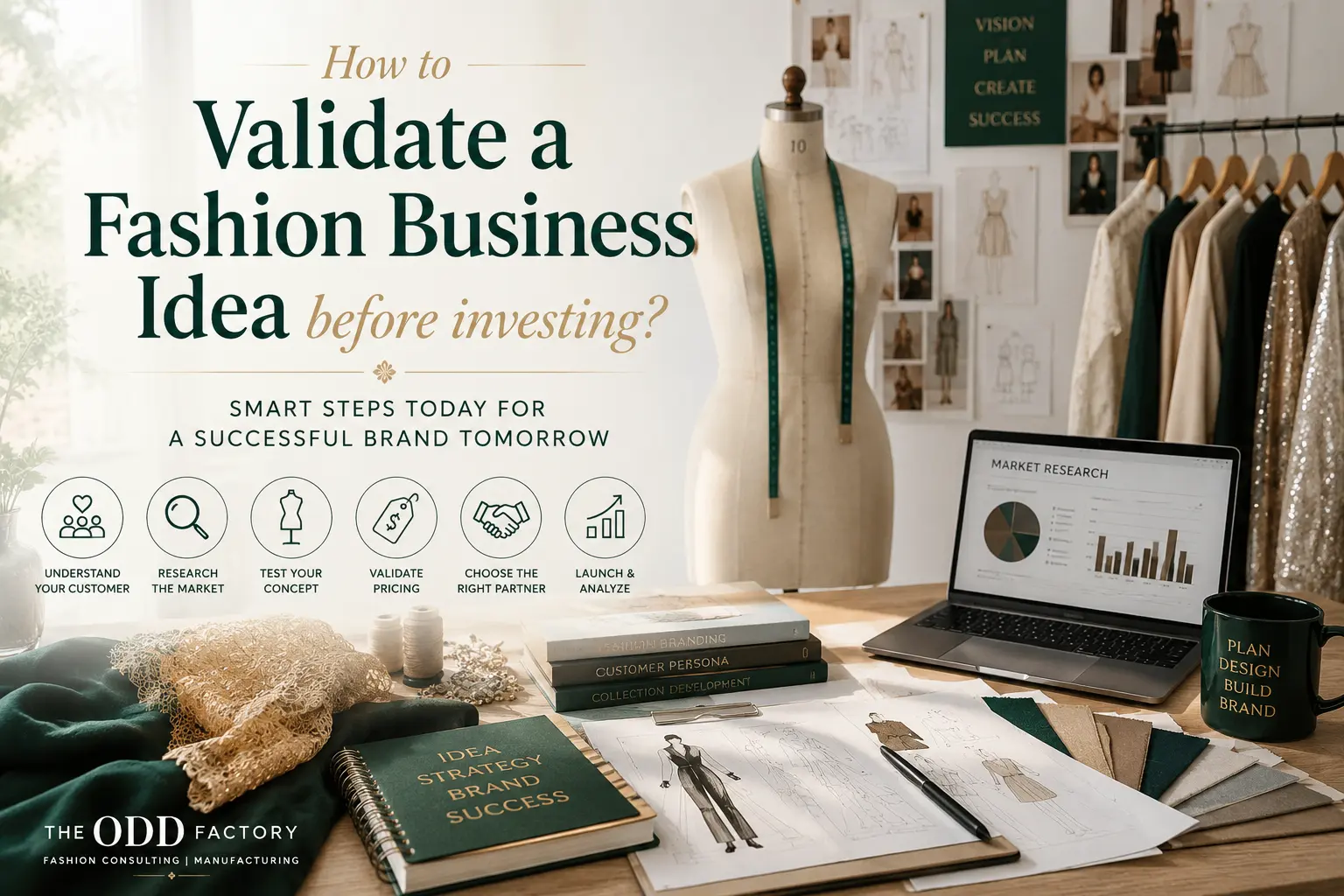
Launching a fashion brand is exciting, but it’s also one of the most competitive industries in the world. Every year, thousands of new brands enter the market with innovative designs, only to struggle because they invest heavily before confirming whether customers actually want their products.
A successful fashion business begins with validation, not production. Before spending money on fabrics, manufacturing, branding, or marketing, founders should take the time to understand whether their idea solves a genuine customer need and has the potential to generate sustainable sales.
Validating your business idea reduces financial risk, improves decision-making, and helps you build a brand with confidence.
Why Validation Matters
Many first-time founders believe that having a unique design is enough to build a successful brand. While creativity is important, it doesn’t guarantee market demand.
Validation helps answer critical questions before major investments are made. It reveals whether customers are willing to pay for your products, whether your pricing is realistic, and whether your brand stands out in a crowded market.
Rather than relying on assumptions, validation allows you to make decisions based on real customer feedback and market insights.
Start by Defining Your Ideal Customer
Every successful fashion brand serves a specific audience.
Instead of trying to appeal to everyone, identify exactly who your products are designed for. Consider factors such as age, lifestyle, profession, purchasing habits, fashion preferences, and budget.
For example, a luxury resort wear brand targeting Dubai consumers will require a completely different strategy than a sustainable streetwear label aimed at young professionals in Mumbai.
The more clearly you understand your customer, the easier it becomes to create products they genuinely want.
Study the Existing Market
Market research is one of the most valuable investments you can make before launching.
Study brands operating in your chosen segment and analyze their pricing, product range, customer reviews, materials, marketing strategies, and positioning.
Instead of asking, “How can I copy them?” ask, “What gap can I fill that they aren’t addressing?”
Finding your unique position is often more valuable than following existing trends.
Create a Minimum Viable Collection
Rather than producing a full collection of 30 or 40 styles, begin with a small, focused range.
A Minimum Viable Collection allows you to test customer interest without investing heavily in inventory.
Choose a few products that best represent your brand identity and solve a clear customer need. This approach reduces risk while providing valuable insights into customer preferences.
Validation Process
Stage | Objective |
Market Research | Understand competitors and customer demand |
Target Audience | Define your ideal customer profile |
Product Concept | Develop a focused product offering |
Sample Development | Create high-quality prototypes |
Customer Feedback | Gather opinions from potential buyers |
Pricing Validation | Test willingness to pay |
Small Launch | Release a limited collection |
Analyze Results | Refine products based on data |
Scale Production | Invest after proven demand |
Invest in Professional Samples
Your sample garments represent your brand before production begins.
High-quality samples allow customers to experience the fit, fabric, construction, and overall quality of your products. They also provide valuable content for photoshoots, social media, and buyer presentations.
Working with experienced manufacturers during sampling helps identify production improvements before moving into bulk manufacturing.
Test Customer Interest Before Manufacturing
One of the most effective ways to validate a fashion business is by collecting feedback before production.
Share prototypes with your target audience, gather opinions through surveys, conduct interviews, or showcase your products at pop-up events.
Pay close attention to recurring feedback about design, fit, comfort, and pricing.
Validation is not about hearing compliments. It is about discovering opportunities to improve.
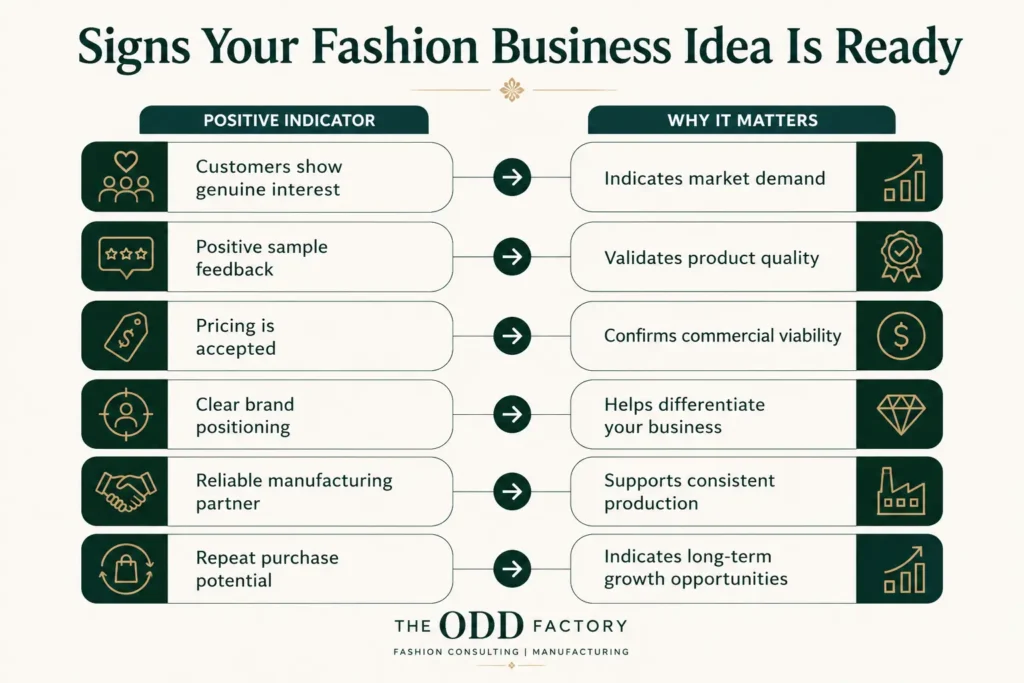
Signs Your Fashion Business Idea Is Ready
Evaluate Your Pricing Strategy
Pricing should reflect both customer expectations and business sustainability.
Calculate your production costs, packaging, shipping, marketing expenses, and desired profit margins before setting retail prices.
Then compare your pricing with competing brands in the same market.
If customers perceive your products as offering greater value than similarly priced alternatives, your pricing strategy is likely on the right track.
Build Your Brand Story Early
Customers increasingly buy into stories rather than products alone.
Before launching, define:
- Why your brand exists
- What values it represents
- Who it serves
- What makes it different
- Why customers should trust it
A compelling brand story helps create emotional connections that influence purchasing decisions.
Work With the Right Manufacturing Partner
Choosing a manufacturing partner is about more than production capacity.
An experienced manufacturer can provide guidance on fabric selection, product development, sampling, cost optimization, quality improvements, production planning.
This expertise often saves startups significant time and money.
Validate Before Scaling
One common mistake among startups is investing in large production runs before confirming product demand.
Instead, launch a limited collection, monitor sales, gather customer feedback, and refine your products based on real-world performance.
Scaling becomes far less risky when supported by proven demand.
Common Validation Mistakes
Many founders rush into production because they fear competitors will launch first. However, skipping validation often leads to unsold inventory, poor customer feedback, and unnecessary financial losses.
Other common mistakes include relying solely on opinions from friends and family, ignoring customer feedback, underestimating production costs, and attempting to launch too many products at once.
Successful brands view validation as an ongoing process rather than a one-time exercise.
The Value of Fashion Consulting
Validation becomes significantly easier with experienced guidance.
Fashion consultants help founders evaluate ideas objectively, identify market opportunities, refine product concepts, and develop realistic launch strategies.
Instead of learning through expensive mistakes, founders can make informed decisions supported by industry expertise.
Final Thoughts
A great fashion business starts with a great idea, but it succeeds because that idea has been tested, refined, and validated before significant investments are made.
By understanding your customers, researching the market, developing quality samples, testing demand, and working with experienced manufacturing partners, you dramatically improve your chances of building a successful and profitable fashion brand.
The most successful collections are not simply designed. They are validated before they are produced.
Ready to Validate Your Fashion Business Idea?
At The ODD Factory, we help fashion entrepreneurs turn ideas into commercially viable brands through strategic consulting, product development, sampling, vendor sourcing, and end-to-end manufacturing support.
If you’re planning to launch a fashion label, our Green Room Fashion Startup Workshop and End-to-End Collection Development Vendors List provide the expertise and resources needed to validate your business idea before investing in production.
Explore our services:
Green Room Fashion Startup Workshop
https://theoddfactory.com/product/green-room-fashion-startup-workshop-2-days/
End-to-End Collection Development Vendors List
https://theoddfactory.com/product/end-to-end-collection-development-vendors/